
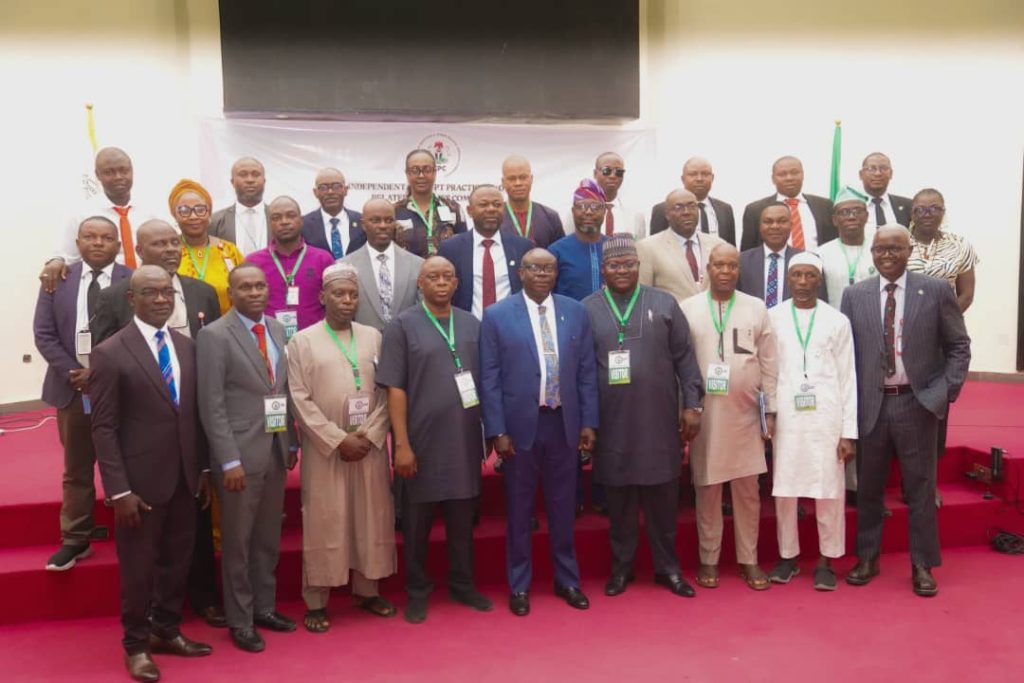
* Shun practices that support contract failures – Dr. Aliyu
* .… there’s no witchaunting in ICPC, all evidence based- Chair. House Committee on Anti-corruption:
By Olawale Lamina
The Chairman of the Independent Corrupt Practices and Other Related Offences Commission, ICPC, Dr. Musa Adamu Aliyu, SAN, has cautioned stakeholders in the procurement ecosystem to steer clear of practices that may be inimical to the spirit of transparency and accountability in the award of projects and its execution, as a way saving the nation from loss of billions of naira in the process.
Dr. Aliyu stated this at one-day engagement workshop organized by the Commission for directors and heads of procurement in government Ministries, Departments, and Agencies (MDAs), on Tuesday at the Auditorium, ICPC headquarters in Abuja.
Represented by the Secretary of the Commission, Clifford Oparaodu, Esq., the ICPC boss who was the Keynote Speaker, charged participants to refrain from practices that constitute challenges to project execution, such as over invoicing, phantom projects, outright abandonment (with mobilization funds fritted away), among others.
He warned of the consequences of graft in the process stating that, “These practices not only drain the treasury but also deny millions of Nigerians clean water, health care, roads and electricity”
But he expressed the confidence that ideas and insights drawn from the workshop will be useful in addressing procurement bottlenecks.
The anti-graft boss called for the need for all to be involved in physically tracking projects, adding that this will help promote transparency, capable of affecting the lives of the citizens positively. He recalled the 2019 launch of the Constituency and Executive Projects Tracking Initiative (CEPTI), which physically monitored projects across all 36 states and the Federal Capital Territory.
Dr. Aliyu assured that the Commission is always available to collaborate with the Bureau of Public Procurement to enhance procurement integrity and check contract failures. He added that procurement process must maximize collaboration and minimize competition to get the best out of it.
The ICPC boss therefore recommended multi-stakeholders partnership and deployment of data analytics to facilitate anomaly detection, while emphasizing that participants must play their roles to sanitize to procurement environment.
Dr. Aliyu equally noted that frontline procurement supervisors must build institutional capacity through training and regular audit to reduce all forms of political pressure on them.
He concluded by charging heads of procurement to collaborate with oversight bodies as partners and not as adversaries saying that, “Corruption thrives in darkness, let us flood our actions with light.”
In his remarks, the Chairman, House Committee on Anti-corruption, Honourable Prince Kayide Moshood Akinolu commended the ICPC “for preventing and not just arresting crimes.”
He noted that the Commission, in carrying out its mandate does not witchaunt anyone but largely deploys evidence and facts. He called for improved partnership with the ICPC by critical stakeholders to enable to anti-graft body discharge its duties optimally.
Prince Akiolu also commended the ICPC’s efforts and charged procurement officers to ensure value for public money.
Addressing the workshop, the Director-General of Bureau of Public Procurement (BPP), Dr. Adebowale Adedokun, extended his organization’s appreciation to the ICPC leadership for boosting compliance with procurement rules.
According to him, the recent approval of the National Infrastructure Development Policy provides a stronger legal framework for prosecuting contractors who deliver substandard projects.
Shedding light on the significance of procurement audits and closer partnership to identify and address infractions, Adedokun noted that, “For the first time, Nigeria now has a clear national document that compels quality and holds contractors accountable. This will strengthen our partnership with ICPC in enforcing compliance.”
The DG, Bureau of Procurement described the collaboration with ICPC as “neighborly and essential,” calling for continued legislative backing for anti-corruption bodies.
Also, the Director-General of the Nigerian Building and Road Research Institute (NBRRI), Professor Samson Duna, noted that building collapse incidents in the country were direct fallouts of poor and substandard materials, some of which often fail the laboratory tests.
The DG acknowledged the ICPC’s role in ensuring proper documentation, site supervision, and contractor compliance, while making recommendation for extension of the rotation period by the Commission beyond six months, in order to improve its oversight.
J
About The Author







