
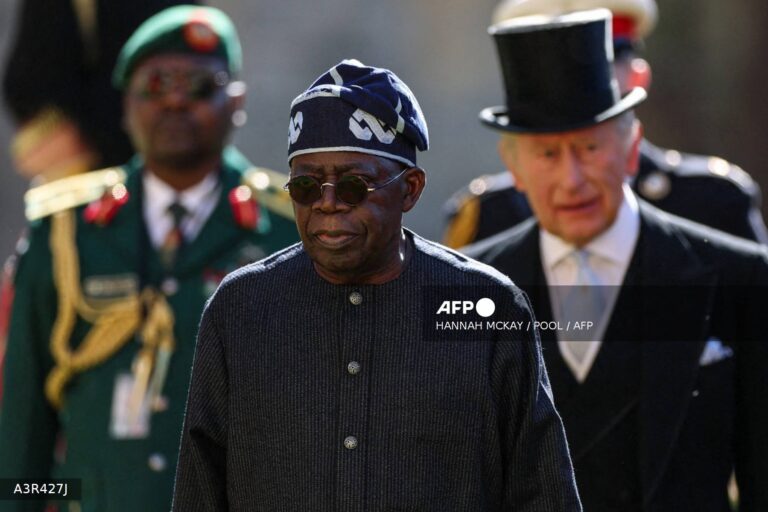
Nigeria's President Bola Tinubu and Britain's King Charles III review a Guard of Honour formed by the 1st Battalion Grenadier Guards, during a ceremonial welcome in the Quadrangle at Windsor Castle, in Windsor, on March 18, 2026, on the first day of a two-day State Visit to the United Kingdom by Nigeria's President. (Photo by Hannah McKay / POOL / AFP)
By Olawale Lamina
The Presidency has criticised former presidential candidate of the Labour Party, LP, Peter Obi, over his criticisms of Nigeria’s delegation to the African CEO Forum in Rwanda and deeper remarks on President Bola Tinubu’s foreign engagements abroad, describing his stand as “populism over the facts.”
Obi had criticized that diplomacy should not be reduced to ceremonies or symbolic displays, emphasizing that international engagements must be assessed by their economic results, arguing that such engagements must translate into measurable economic benefits for citizens.
Obi had gone ahead to compare the huge economic benefits President Trump’s visit to China generated for the United States.
But in a swift reaction, the Special Assistant to the President on Social Media, Dada Olusegun, on Saturday noted that the opposition Politician’s viewpoint fell short of the composition and purpose of Nigeria’s delegation to the Kigali event.
He said: “It is always populism over the facts for Mr Peter Obi, but it is important to put it out there that the Nigerian entourage to the African CEO forum in Rwanda was made up of some of Nigeria’s industrial leaders.”
The Presidency named those on the delegation as including prominent business moguls such as Aliko Dangote, Abdul Samad Rabiu, Tony Elumelu, Wale Tinubu and Jim Ovia, stressing that their participation reflected the seriousness of Nigeria’s engagement at the forum.
The statement further defended President Tinubu’s foreign trips and diplomatic engagements as efforts at securing investment, strengthening trade relations and boosting economic confidence rather than generating “flashy headlines or staged signing ceremonies.”
It added that, “Real diplomacy goes much deeper. It is about strategic dialogue, building investor confidence, strengthening security cooperation, advancing trade discussions, and positioning the country for long-term economic gain, which President Tinubu did all of and more in Kigali and several other state visits.”
In similar breath, the Presidency spoke to comparisons between Nigeria’s diplomatic approach and that of the United States, saying such comparisons lacked context due to differences in global influence and economic structure.
The statement argued that the Tinubu administration has already garnered commitments across key sectors, including energy, technology, agriculture, manufacturing and solid minerals, through sustained international engagements.
“Diplomacy is not a reality TV show where every engagement must end in staged photo-ops before it is considered meaningful,” the statement stressed, adding that state visits should be assessed by their long-term economic impact rather than optics or delegation size.
It described criticisms of delegation size and travel arrangements as misleading, insisting that presidential movements are tied to constitutional, diplomatic and security responsibilities.
It seized the occasion to reaffirm the fact that President Tinubu remains focused on economic recovery, investment attraction and institutional reforms, all targeted at long-term national development.
The Presidency took another jab at Obi, stating that his criss cross across political parties in recent years should remind him of the need to reflect on the importance of stability in governance commentary.
About The Author







