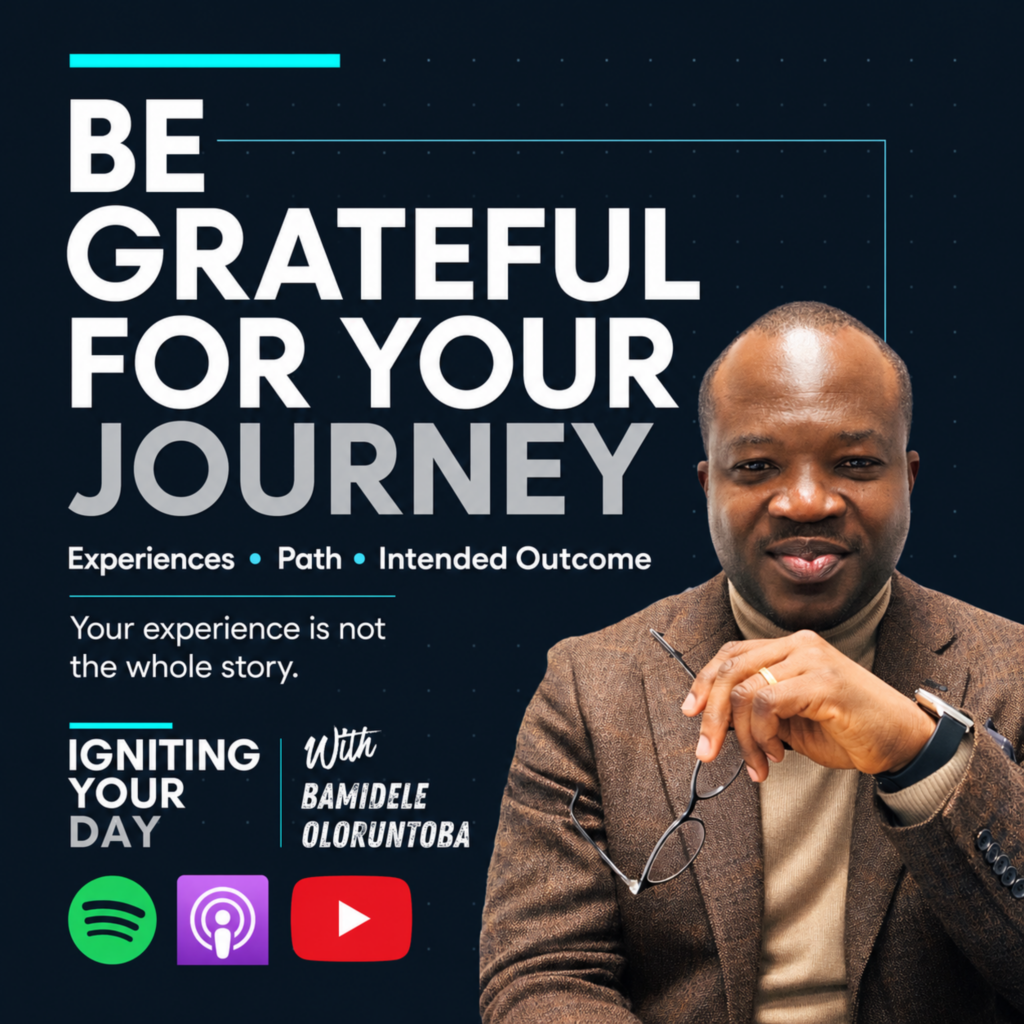
By Bamidele Oloruntoba
Your experience is real, but it is not the whole story. Beyond the moment is a path that led to the moment, and beyond the path is an outcome God desires for you.
Life rarely unfolds in a straight line. Every believer passes through seasons that are easy to understand and others that remain difficult to explain.
Some experiences bring joy. Others leave pain, disappointment, regret or unanswered questions. Some appear highly consequential, while others seem insignificant at first. Yet even the smallest moments can shape our thinking, character and response to God.
The danger is that we can become so focused on what happened to us that we lose sight of the larger journey.
Our experiences are real. They matter. They should not be dismissed or denied. But no single experience tells the whole story of a life.
Beyond the experience is a path. Beyond the path is an intended outcome.
In the Potter’s hands
Jeremiah 18 presents the image of a potter working with clay. God used that picture to remind Israel that His people remained in His hands.
“As the clay is in the potter’s hand, so are ye in mine hand,” God declared in Jeremiah 18:6.
The image points to God’s sovereign authority to shape His people. It does not mean that every painful event is directly caused by Him. It means that no experience places a person beyond His wisdom, oversight or ability to redeem.
A difficult situation does not remove us from the Potter’s hands.
We may be misunderstood by people around us. Our words may be misinterpreted, our intentions questioned and our efforts dismissed. At times, we may even recognise that some of our problems resulted from our own negligence or poor decisions.
Still, God is not surprised by our circumstances. Nothing is beyond His ability to address, redeem and use.
Romans 8:28 reminds believers that God is able to work through all things for the good of those who love Him and are called according to His purpose.
We may feel pain, grieve loss and regret decisions. We may wish that certain things had happened differently. Yet the journey remains under God’s sovereign oversight.
Three dimensions of the journey
There are three things for which we can learn to thank God:
First, our experiences.
Second, the path along which those experiences occurred.
Third, the outcome God intends to produce.
We often isolate the experience. We remember the pain, the disappointment or the embarrassment, but fail to consider the path on which it happened or what the journey may be producing within us.
There is a difference between what we experience, the road we travel and the fruit that emerges from completing the journey.
The experience may have been painful, but it was not necessarily the destination.
It would be unfortunate to remember only that we suffered while overlooking the maturity, wisdom, patience or spiritual depth that God was producing.
The experience matters, but it is not the end of the story.
Look beyond the immediate moment
A person cannot accurately assess an entire life by one difficult season.
When we evaluate ourselves only by how a particular experience feels, we may wrongly conclude that we are failing, abandoned or making no progress.
A correct assessment requires a wider view.
The question is not only, “What happened to me?”
We must also ask, “What is this journey producing in me?”
This is where maturity begins. It begins when we stop looking only at the pain of the moment and start recognising the larger work taking place within us.
Your experience is part of a journey, and the journey has an outcome.
Counting it all joy
James 1:2–4 instructs believers to count trials as joy because the testing of faith produces patience, maturity and completeness.
This instruction does not ask us to pretend that pain is pleasant. It does not deny tears, disappointment or regret.
Rather, it invites us to look beyond the immediate experience and consider what the trial can produce.
Think about the experiences that made you cry. Think about the nights when you questioned God, regretted a decision or wondered why you had been placed in a particular situation.
The biblical response is not denial. It is perspective. We count it all joy because the trial is not the whole story. God is not a time-waster. He is not a life-waster. He is not an experience-waster.
A painful season can become part of the maturity for which we have prayed.
Maturity is not the absence of tears. It is the ability to acknowledge the pain while still trusting that God can produce something meaningful through the journey.
The journey is greater than one moment
There are times when we pray, fast and seek God while focusing only on a particular experience.
We ask why something happened. We wonder why a relationship failed, why people misunderstood us or why a season lasted longer than expected.
But growth requires us to recognise that there is something greater than the experience.
There is a journey.
Some trials may reveal our strength. Others may expose our weakness. In some situations, we may feel that we responded well. In others, we may believe that we failed.
Yet one failure should not become the final assessment of an entire life.
To understand our progress, we must look at the journey and consider the outcome God is producing.
Remember how God preserved you
In Deuteronomy 8, Israel was told to remember the entire wilderness journey.
The wilderness involved hunger, testing, uncertainty, discipline and dependence. Yet God also reminded the people that their clothes did not wear out and their feet did not swell.
This was a picture of preservation.
Some of the things we endure are known only to us. Others may never fully understand how painful they were.
Yet here we are.
We are still standing.
We are still praying.
We are still serving.
We are still moving forward.
The fact that we can continue does not mean the pain was insignificant. It means the pain did not completely incapacitate us.
We may have cried, grieved and struggled, but our feet did not swell.
We can still rise and say, “Lord, here I am.”
That is a reason for gratitude.
Thank God for the path
Psalm 66 describes a journey through testing, affliction, fire and water. But the passage does not end there. It speaks of God bringing His people into a place of abundance and fulfilment.
The fire was real.
The water was real.
The pressure was real.
But they were not the final destination.
Where we are now does not have to be where our story ends.
The path may be uncomfortable, but it is not necessarily purposeless.
It may be painful, but it is not empty.
It may be confusing, but it remains under the supervision of the Potter.
We do not thank God because everything that happened was pleasant. We thank Him because the path is not beyond His power to redeem.
Trust the intended outcome
Isaiah 48:17–19 reveals God as the One who teaches His people what is best and leads them in the way they should go.
The passage also shows what God desired to produce: peace like a river, righteousness like the waves of the sea, descendants like the sand and a legacy that would not be destroyed.
God was not leading His people without purpose.
The journey had an intended outcome.
Many times, we misinterpret our lives because the immediate experience is too painful. We become so occupied with what happened that we fail to recognise what God may be producing.
But God has an outcome in view.
This does not remove human responsibility. Isaiah 48 connects the promised outcome with paying attention to God’s instructions.
The journey calls us not only to endure, but also to listen and obey.
Our prayer should therefore be:
“Lord, as You lead me through this journey, help me to pay attention to Y
our instructions.”
A journey that blesses others
God’s intended outcome often extends beyond personal survival.
The journey is not only about what God produces in us. It is also about what He produces through us.
Our growth can bless our families, churches, communities and future generations. The lessons we learn can become wisdom for others. The strength God develops in us can create an atmosphere in which others are encouraged to pray, trust and seek Him.
A journey can produce spiritual children, protégés, disciples and people who carry the same burden into another generation.
The outcome is not merely endurance.
It is multiplication.
Your journey is not a waste
Your tears are not the whole story.
Your disappointment is not the whole story.
Your regret is not the whole story.
Your misunderstanding is not the whole story.
Your failure in one moment is not the whole story.
There is an experience.
There is a path.
And there is an intended outcome.
God is not wasting your time, your life or your experiences.
Remain in the Potter’s hands.
Pay attention to His instructions.
Allow patience to complete its work.
Remember how He preserved you.
Thank Him for the path.
Trust Him for the outcome.
And let this become your declaration:
Lord, I thank You for my experiences. I thank You for the path You chose to take me through. I thank You for the outcome You intend to produce through my journey. My journey is not a waste.
Keep reading A Word for You in The Pinnacle Times every Friday
About The Author