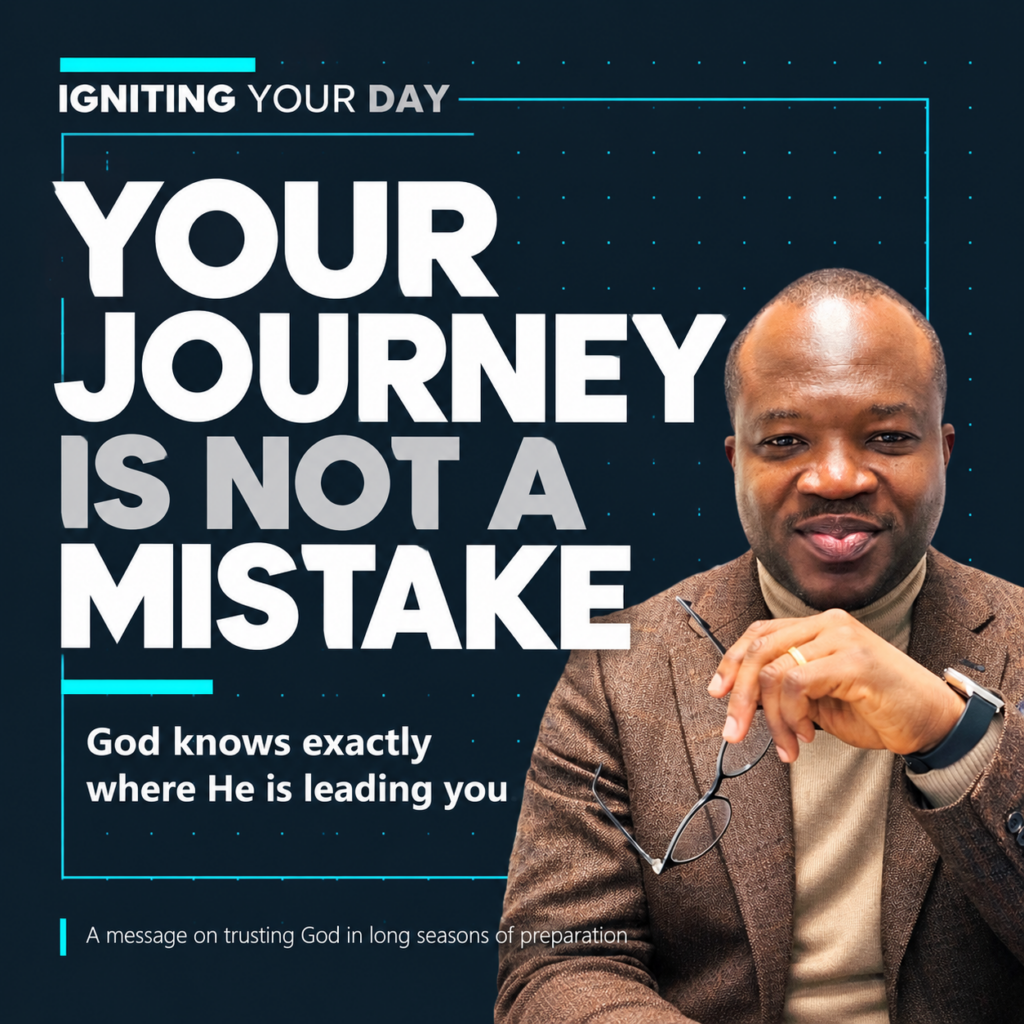
Why the Longer Road May Be Part of God’s Preparation
There are seasons in life when the greatest challenge is not simply that the road is difficult, but that it seems unnecessarily long.
You know where you hope to go. You can see what appears to be a shorter route. You may even watch others arrive at places you have been praying to reach. Yet your own journey continues through waiting, uncertainty, repeated lessons and unexpected discomfort.
For anyone asking why the process is taking so long, there is a simple but important encouragement:
Your journey is not a mistake.
The length of the road does not necessarily mean that God has forgotten you. The slower pace does not automatically mean that something has gone wrong. Sometimes, the longer journey is itself part of the preparation.
When God Chooses the Longer Road
One of Scripture’s clearest illustrations of this appears in Exodus 13:17–18.
When the Israelites left Egypt, there was a shorter route toward their destination. God knew it existed. Yet He deliberately did not lead them that way.
Why?
Because He knew what they were not yet prepared to face.
The shorter path would have exposed them to conflict with the Philistines, and God knew that encountering such resistance too early could cause them to lose courage and return to Egypt.
The issue was therefore not simply distance.
It was readiness.
A shorter road is not always the safest road, and a faster arrival is not always the wisest outcome.
Sometimes God is doing more than taking a person somewhere. He is preparing that person for what will be required when they arrive.
This changes the way difficult seasons can be understood.
The longer route may be building character.
The delay may be strengthening conviction.
The waiting may be developing endurance.
The slower pace may be creating a depth that a faster journey could never produce.
God may be more concerned with who a person becomes on the journey than with how quickly that person reaches the destination.
Understanding the Shaping Process
Deuteronomy 32:8–12 provides another powerful picture of how God develops His people.
The passage describes God finding His people, surrounding them, instructing them, guarding them carefully and, like an eagle, stirring the nest before carrying them forward.
Taken together, these images reveal a pattern of spiritual formation.
The difficulty is that many people do not recognise the stage they are in.
What feels like abandonment may actually be instruction.
What feels like repetition may be training.
What feels like disruption may be preparation for movement.
Understanding the process can make the difference between becoming discouraged and remaining faithful.
First Comes Encounter
Every meaningful spiritual journey begins with an encounter.
Moses experienced such a moment in Exodus 3 when he saw the burning bush. What began as an unusual sight became a life-changing encounter with God.
His circumstances did not immediately become easier. In fact, his assignment became considerably more demanding.
But something had changed: Moses had become conscious of God’s call upon his life.
There are moments when God’s presence and purpose suddenly become personal.
A truth once heard becomes a conviction.
A Scripture once familiar becomes alive.
A calling once vague becomes unmistakable.
That encounter does not complete the journey. It begins it.
Then God Encircles the Life
Deuteronomy 32:10 says that God “encircled” His people.
Following an encounter, God often allows experiences that continually reinforce what He has already revealed.
What seemed like a single spiritual moment begins appearing in everyday circumstances.
A sermon heard on Sunday may suddenly become relevant in a challenge faced on Monday.
A lesson about faith may be followed almost immediately by a situation that demands faith.
A word about patience may be tested through delay.
These moments can easily be misunderstood.
People may assume that opposition means the earlier revelation was false. Yet sometimes the challenge is precisely where the lesson begins to take root.
Jacob experienced something similar in Genesis 28. After his encounter at Bethel, he realised that God had been present in a place he had previously regarded as ordinary.
That recognition remains important today.
God’s activity is not limited to dramatic experiences. His fingerprints can often be found in the ordinary events through which convictions are reinforced and faith is exercised.
The Classroom of Instruction
The next stage is instruction.
Deuteronomy says God instructed His people.
Here, inspiration begins to become discipline.
A person may sense the need to pray consistently, study Scripture more deeply, serve faithfully, develop a particular ability or obey God in an area that appears insignificant.
Not every instruction will be spectacular.
In fact, some of the most important preparation takes place through routine.
Isaiah 50 describes the picture of someone whose ear is awakened “morning by morning” to receive instruction.
There is something powerful about that phrase.
Spiritual maturity is rarely built through occasional dramatic moments alone. It is often developed through repeated acts of obedience.
Prayer after prayer.
Morning after morning.
Decision after decision.
Routine can easily be mistaken for stagnation, but consistency is often God’s classroom.
The lesson being learned today may become the capacity required tomorrow.
Discovering What God Has Placed Within You
Deuteronomy 32 also describes God keeping His people as “the apple of His eye”.
During the shaping process, people often begin discovering what is distinctive about the way God has made them.
Certain responsibilities seem natural.
Specific burdens continually return.
Some find themselves drawn toward prayer. Others toward teaching, encouragement, leadership, generosity, service or hospitality.
Psalm 122:1 captures the joy of someone who delighted in going to the house of God. That delight revealed something about his spiritual appetite.
In a similar way, the things that consistently stir a person’s heart can become clues to areas of grace and purpose.
But uniqueness must be understood correctly.
A gift is not primarily a platform for recognition.
It is an opportunity for service.
Ephesians 2:10 describes believers as God’s workmanship, created for good works. First Peter 2:9 similarly presents God’s people as those called to display His excellence.
The goal is therefore not simply to become visible.
It is to allow something of God’s nature to become visible through the life He has shaped.
When God Stirs the Nest
Perhaps the most uncomfortable stage appears in Deuteronomy 32:11, where God’s care is compared with an eagle stirring its nest.
A nest is comfortable.
It is familiar.
It represents stability.
But young eagles were not created to remain there forever.
There are seasons when the conditions that once felt comfortable begin to change.
A workplace becomes difficult.
Relationships become demanding.
A familiar environment no longer provides the same sense of security.
A spiritual routine that once felt easy suddenly requires greater conviction.
Sometimes such experiences reveal problems that need to be addressed. Harmful behaviour should never be excused by casually claiming that God caused it.
Yet even within painful circumstances, God can use adversity as a tool of formation.
Discomfort can expose dependence on comfort.
Pressure can reveal whether conviction is genuine.
Uncertainty can deepen reliance on God.
The stirring of the nest does not necessarily mean the journey has failed.
Sometimes it means that another stage is beginning.
An eagle disturbs the nest not because it wants to destroy its young, but because they were created to fly.
Preparation Eventually Becomes Expression
The process described in Deuteronomy does not end in the wilderness.
Verses 13–14 describe God bringing His people into fruitfulness and abundance.
That progression matters.
Formation has a purpose.
There eventually comes a season when what has been developed privately becomes useful publicly.
Lessons become wisdom.
Discipline becomes capacity.
Character becomes stability.
Gifts become service.
The person who once questioned the wilderness may eventually understand why it was necessary.
Exposure, in this sense, is not merely about becoming known.
It is about becoming ready for opportunities, responsibilities and assignments that would have overwhelmed an earlier version of the same person.
There are doors that ability alone cannot sustain.
Character must be able to carry what opportunity introduces.
That is why preparation should not be despised.
The Process Has an End
Ecclesiastes 7:8 teaches that the end of a matter can be better than its beginning, while Galatians 6:9 encourages believers not to become weary in doing good because there is a harvest in due season.
The message is not that every painful situation will unfold exactly as expected.
Nor is it that every delay should automatically be interpreted as divine intervention.
The encouragement is that waiting does not have to be meaningless.
A difficult season can still produce something valuable.
A long journey can still form strength.
A hidden season can still prepare a person for meaningful expression.
For those currently walking through such a process, perhaps the question should not only be, “When will this end?”
Another question may be equally important:
“What is being formed in me while I am here?”
That question changes the posture of waiting.
Instead of seeing every delay only as an obstacle, it creates room for discernment.
Instead of despising routine, it encourages faithfulness.
Instead of interpreting every difficulty as abandonment, it makes space for the possibility that growth is occurring beneath the surface.
When Marriage Must Look Beyond Itself
The same principle of purpose also applies to marriage.
A healthy marriage rightly requires attention to intimacy, communication, friendship, financial stability and the wellbeing of the family.
But Christian marriage can carry a purpose beyond the private happiness of two people.
A home can become a place of hospitality.
A couple can become an example of faithfulness.
Their combined gifts can serve others.
Their relationship can provide strength, encouragement and spiritual influence beyond their immediate household.
Second Corinthians 5:14–15 teaches believers not to live merely for themselves, but for Christ.
Applied to marriage, that principle suggests that a Christian union should increasingly become outward-looking.
The question eventually becomes more than, “Are we happy together?”
It also becomes:
“How can our life together serve God and bless others?”
Marriage can become inward-looking when one or both partners remain emotionally or spiritually immature. Decisions may revolve entirely around personal preferences and immediate comfort, leaving little room for a wider sense of purpose.
Where such a pattern exists, correction should be approached carefully.
Accusation is rarely the best starting point.
Conversation should begin with listening, kindness and humility.
One spouse may already recognise the problem but feel uncertain about how to address it. Another may never have considered that marriage itself can carry an assignment beyond the couple.
The goal should not be condemnation.
It should be growth.
Love within the home should eventually become grace flowing beyond the home.
A Question Worth Asking Today
Every person is somewhere in the process of becoming.
For some, this may be a season of encounter.
For others, instruction.
For some, routine.
For others, discomfort.
And for some, a long season of preparation may finally be giving way to greater expression.
Whatever the stage, the length of the process should not automatically be interpreted as failure.
The longer road may contain lessons the shorter road could never teach.
The waiting may contain formation that immediate success could never produce.
The wilderness may be developing the strength necessary for what comes next.
So before concluding that the journey has gone wrong, consider another possibility:
Perhaps the road is longer because preparation is deeper.
Perhaps the pace is slower because the responsibility ahead is greater.
Perhaps what feels like delay is also development.
The same God who knows the destination also knows what must be formed along the way.
About The Author