Marwa: NDLEA in five years arrested 96,157 drug offenders, 250 drug barons, seized more than 15.8 million kilogrammes of assorted illicit drugs and secured 16,691 convictions.
By Olawale Lamina
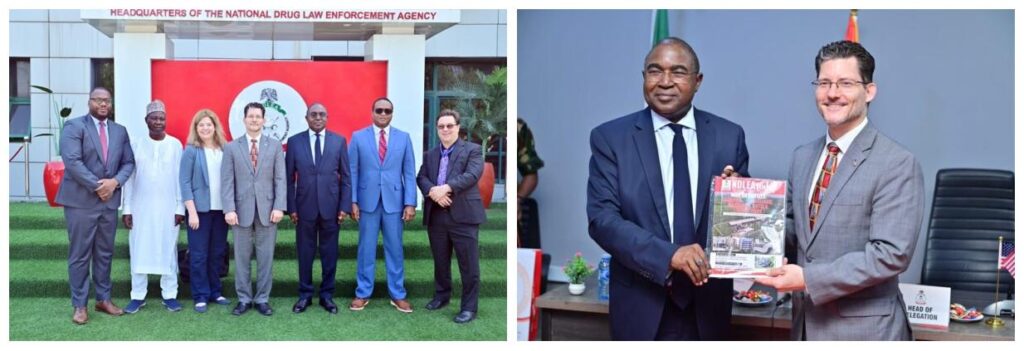
The United States Deputy Assistant Secretary of State for International Narcotics and Law Enforcement Affairs, INL, for Africa and the Middle East, Michael Gonzales, has commended the National Drug Law Enforcement Agency ,NDLEA, for successes recorded in its activities in Nigeria, being the first country to visit upon his appointment.
Gonzales stated this Tuesday, during a visit to the NDLEA national headquarters in, Jahi Abuja. He was received by the Chairman/Chief Executive Officer, Brigadier General Mohamed Buba Marwa (rtd.), and members of the management team of the agency.
Gonzales, who was appointed into his new role four months ago, said the choice of Nigeria was because of its position as a continental leader and economic powerhouse, and based on the impressive leadership cum its operational achievements.
The US Deputy Assistant Secretary of State for International Narcotics and Law Enforcement Affairs, INL, Africa and the Middle East, said he came to witness on the spot how the NDLEA’s successes were being recorded.
Gonzales specifically referenced four methamphetamine laboratory busts recorded during the year as a marker of the agency’s effective operational practices, including intelligence-led investigations, inter-agency and cross-border cooperation, operational excellence, and thorough investigations and prosecutions.
He pointed out that narcotics remained one of the foreign policy issues with the most direct impact on American communities, even as he highlighted that the international drug trade operated across borders with few constraints. He also acknowledged that activities the of the INL and the NDLEA was delivering tangible benefits to both Nigerians and Americans.
The US official informed that more than four decades of INL partnerships with countries worldwide had involved training and equipment support.
He hinted that pressure on drug cartels in the Western Hemisphere could redirect trafficking routes towards Africa, Europe and Oceania, while noting that there had been growing shift from plant-based drugs to synthetic substances, which can be more difficult to detect and more dangerous, stressing the need for sustained action against transnational criminal organisations and their financial networks.
Responding, Gen. Marwa described partnership between the NDLEA, the INL and the United States Drug Enforcement Administration as a shared investment in the security of both countries. He stressed that the convergence of drug trafficking, arms smuggling and terrorism required coordinated action. According to him,proceeds from drug trafficking could finance weapons acquisition and sustain armed groups proliferation.
The NDLEA boss stated that the agency’s operatives had succeeded in dismantling what he described as Nigeria’s largest clandestine methamphetamine laboratory, located in a forest in Ijebu East, Ogun State. He disclosed that the operation resulted in the arrest of three Mexican methamphetamine experts and their Nigerian collaborators.
Marwa said that illicit substances valued at more than $360 million were recovered during the operation, adding that the agency subsequently raided another industrial-scale laboratory in Tapa Village, Oyo State and arrested a Mexican methamphetamine expert and four Nigerian collaborators.
He said that similar facilities had been dismantled in Enugu and Ebonyi states, with the operations linked to Mexican drug cartels.
Gen. Marwa used the opportunity to underscore the fact these activities indicated an attempt to turn Nigeria into a drug manufacturing hub for international markets.
He equally revealed that the drug cartels operated seeking alternative trafficking corridors, after being confronted by increased pressure on their operations in the Western Hemisphere.
He disclosed that dismantling methamphetamine laboratories in Nigeria could help prevent illicit drugs from reaching American and other international markets.
The NDLEA Chairman, Chief Executive Officer appreciated the contributions of INL in the areas of assistance to the agency’s forensic and chemical analysis capabilities, professional training, financial crime investigations and equipment maintenance.
Marwa revealed that NDLEA had in the past five years, arrested 96,157 drug offenders, including 250 drug barons, seized more than 15.8 million kilogrammes of assorted illicit drugs and secured 16,691 convictions.
While urging the US government to sustain, or increase its assistance for the country, he warned that any withdrawal of INL’s assistance could create gaps that criminal and terrorist networks might exploit in future.
He concluded his remarks by stating that traffickers, arms dealers and terrorist groups united across borders, making sustained international collaboration necessary to curbing the menace.
The international drug trade is a global black market worth hundreds of billions of dollars annually, accounting for roughly 1% of all global trade. Managed by sophisticated, highly adaptive criminal syndicates and cartels, it involves the cultivation, manufacture, distribution, and sale of substances subject to strict prohibition laws.
Major Global Drug Categories & Production Hubs
• Cocaine: Primarily cultivated and processed in South America (Colombia, Peru, and Bolivia), then trafficked heavily into North America and Europe.
• Heroin and Opium: Sourced predominantly from Afghanistan (the Golden Crescent) and Southeast Asia’s Golden Triangle (Myanmar and Laos). Afghanistan historically accounts for the vast majority of the world’s illicit opium.
• Synthetic Drugs: Methamphetamine, captagon, and synthetic opioids like fentanyl represent the fastest-growing sector. Production relies heavily on illicit precursor chemicals diverted from legal industrial supply lines.
Evolving Logistics & Emerging Hubs
Traffickers exploit porous borders, weak customs protocols, and corrupt networks. While historical corridors remain highly active, major transatlantic shifts have occurred:
• The African Transit & Production Pivot: Latin American cartels (such as Mexico’s Sinaloa Cartel) have heavily expanded operations into West, South, and East Africa. Nations like Nigeria and South Africa are no longer just transit corridors to Europe and Asia; they have become active manufacturing hubs for high-profit methamphetamine due to cheap labor, accessible shipping routes, and vast ungoverned spaces.
• The Balkan & Northern Routes: Massive supply corridors move heroin from Afghanistan through Central Asia and Iran into Western Europe and the Russian Federation.
International Frameworks & Law Enforcement
The global response to trafficking is dictated by three major United Nations treaties managed under the United Nations Office on Drugs and Crime (UNODC):
1. Single Convention on Narcotic Drugs (1961): Establishes strict controls over plant-based drugs (opium, coca, cannabis).
2. Convention on Psychotropic Substances (1971): Controls synthetic stimulants, psychedelics, and depressants.
3. Convention against Illicit Traffic (1988): Empowers nations to track and seize asset proceeds, police precursor chemicals, and execute cross-border extraditions.
International bodies like INTERPOL coordinate joint sting operations to disrupt the convergence of drug trafficking with money laundering, illegal firearms, and terrorism financing.
If you are exploring a specific angle of this topic, let me know if you would like to focus on:
• The economic impact and how drug cartels launder their billions
• The fentanyl crisis and its specific supply lines into North America
• The effectiveness of the “War on Drugs” versus alternative policy models (like universal legalization or public health approaches)
Wikipedia
Illegal drug trade – Wikipedia
Definition: Global black market for cultivation, manufacture, distribution, and sale of prohibited drugs (US$426–$652 billion in 2014, ~1% global trade). Histor…
United Nations Office on Drugs and Crime
Drug trafficking – UNODC
Drug trafficking is a global illicit trade involving the cultivation, manufacture, distribution and sale of substances which are subject to drug prohibition law…
Interpol
Drug trafficking
The issues Criminal networks traffic a range of drugs including cannabis, cocaine, heroin and synthetics such as methamphetamine and fentanyl. As international …
Welcome to the United Nations
Drug Trafficking | United Nations and the Rule of Law
Definition: Drug trafficking is the global illicit trade involving the cultivation, manufacture, distribution, and sale of prohibited substances, which undermin…
United Nations Office on Drugs and Crime
International drug control: how it works
International drug control: how it works How are drugs controlled internationally? There are three major international drug control treaties. These Conventions …
EBSCO
Drug trafficking | Law | Research Starters | EBSCOhost
Drug trafficking Drug trafficking refers to the illicit trade of controlled substances, a global black market involving the farming, processing, distribution, a…
YouTube·DW News
3m
Nigeria busts $300M meth empire: How West Africa became a drug hub
Africa Defense Forum
Mexican Cartels Targeting Africa as Meth Production Hub
20 Oct 2026 — Major laboratory busts in South Africa and Nigeria show that Africa is shifting from its historic role as a drug trafficking corridor into a …
Facebook·Punch Newspapers
Mexican cartels turning Nigeria into meth hub
The mastermind, Anochili Innocent, was arrested at his luxury fortress in Lekki’s Golf Estate, with the passports of the Mexican technicians found in his home, …
YouTube·SABC News
3:01
Drug syndicates exploit African shipping routes
TheCable
US commends NDLEA over busts of meth labs linked to Mexican cartels
20 Oct 2026 — He said the international drug trade had few boundaries, adding that the partnership between INL and the NDLEA “fundamentally delivers for …
About The Author