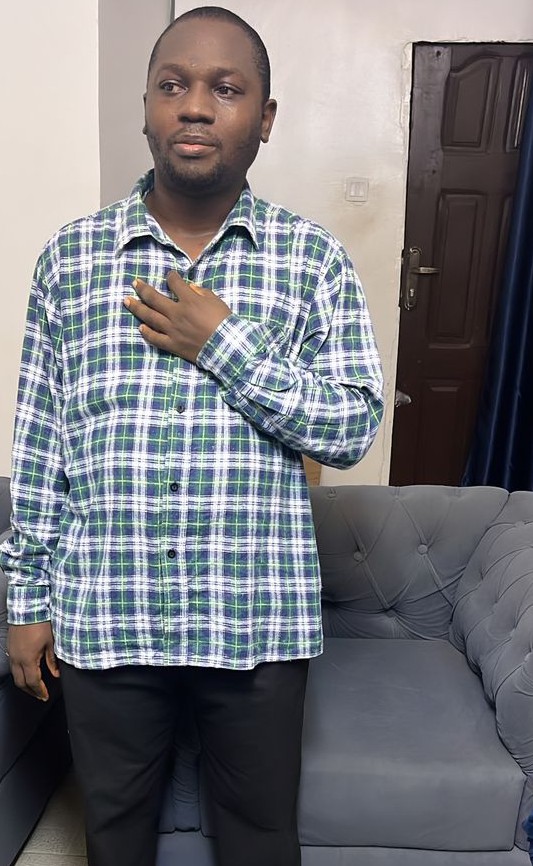
By Afolabi Yusuf Olawale
INTRODUCTION: In our Hope For The Special Needs Series, The Pinnacle Times presents a visionary, ambitious young man who is physically challenged, but braving all odds with his passion by advocating the cause of the blind in society.
PROFILE: Afolabi Yusuf Olawale, born May 26, 1998, is a testament to resilience. An Oyo State native, Afolabi lost his sight in the early 2000s but persevered. He attended Pacelli School for the Blind (2004-2011), King’s College Lagos (2011-2017), and graduated from Nnamdi Azikiwe University Awka (2019-2023) with a degree in History and International Studies. Afolabi has also earned professional certifications from CISCO and Coursera, demonstrating his commitment to lifelong learning. He is a bona-fide scholar of MTN, further showcasing his academic prowess. Now 26, Afolabi continues to navigate life with grace and determination, inspiring others to overcome challenges.Afolabi Yusuf Olawale is a young disability advocate for more than ten years and a volunteer to a UK based disability organisation, Africa disability Empowerment Network (ADEN), now Access for Disability for more than eight years.
The saying “Love is not blind” rings truer than ever when we challenge the outdated belief that a blind person cannot marry a sighted person. This misconception, sadly prevalent in some Nigerian communities, families, and even religious houses, holds back love and creates unnecessary barriers. It’s like the proverb says, “Don’t judge a book by its cover,” because true love transcends physical appearances and limitations.
Love, in its purest form, is about shared values, emotional connection, and mutual support.
Blindness does not diminish a person’s ability to love, cherish, and build a fulfilling life with a partner. In fact, the proverb “Where there’s a will, there’s a way” is embodied by blind individuals who often possess unique strengths – heightened senses of touch, hearing, and intuition – that enrich the experience of love.
Furthermore, the world of technology has transformed the lives of the blind. We now have access to assistive devices like screen readers, braille displays, and GPS systems that bridge the gaps created by visual limitations. These tools empower us to navigate the world independently, pursue our passions, and contribute meaningfully to society. It is a testament to the truth that “Necessity is the mother of invention.”
Let’s remember that blindness is not a curse, but a challenge that can be overcome. It’s an opportunity to explore the world through different senses, to develop unique skills, and to find joy in the richness of human experience.
Through both formal and informal education, blind individuals acquire skills that equip us to function as professionals in various aspects of life. We are not bereft of the ability to manage a well-to-do family; in fact, we often demonstrate exceptional resourcefulness and resilience.
It’s disheartening to see families forbidding their children from pursuing love with a blind person, and religious leaders painting disability as a spiritual problem. It’s time for a change in mindset. If you’re asking so-called “able-bodied” congregants to thank God for not living with disabilities, what would you ask a person living with a disability to thank God for? This type of preaching is derogatory and discriminatory.
It’s time to embrace inclusivity and understanding. It’s time to celebrate the richness and diversity of human relationships. Let us embrace the truth that love is not blind, but rather a powerful force that can overcome any obstacle, fostering a world where love knows no bounds.
About The Author