
Protesters should conduct themselves in appropriate context …
By Olawale Lamina
” Without a doubt, the aggregate impact on the cost of goods and services truly reflects a disruption on the quality of life of the average Nigerian. We are however not unmindful of the President’s admonition at different times to the generality of Nigerians on the possible consequential impact of the reforms. We share in the President’s standpoint on this matter. No reform of the magnitude being undertaken can succeed without some forms of pain.”
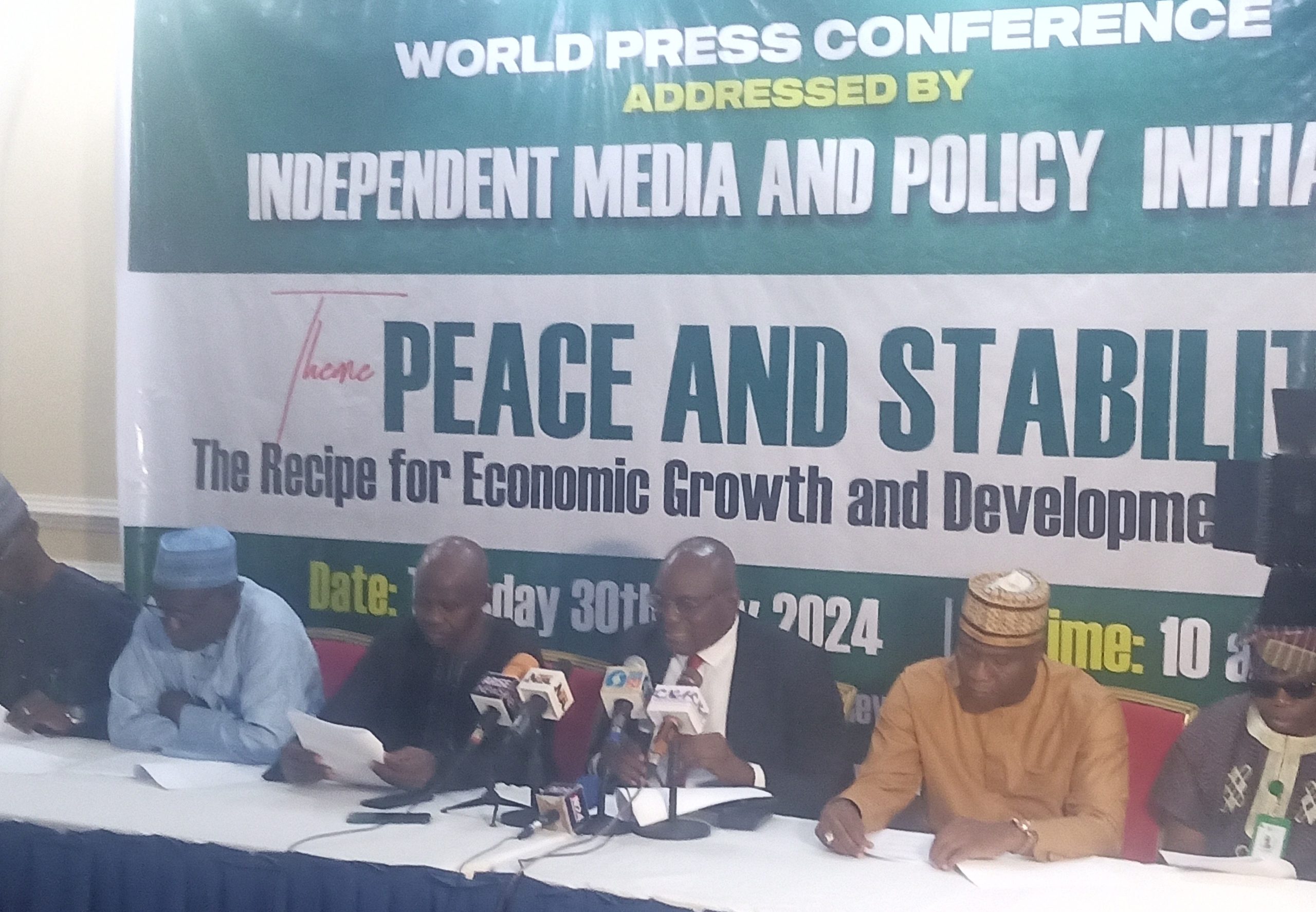
A policy think-thank, Independent Media and Policy Initiative, IMPI, has enumerated a number of reforms, programmes and positive steps so far taken by the President Bola Tinubu-led government to mitigate the harsh economic conditions triggered by food inflation in the country, as part of moves to set the record straight and possibly dissuade organizers of planned nationwide protests to shelve their plans and join hands in support of the administration.
This was contained in an address delivered by the MPI Chairman, Niyi Akinsiju at a just concluded World Press Conference which took place at the Nicon Luxury Hotel, Federal Capital Territory, Abuja on Tuesday.
Mr. Akinsuyi stated that the press conference was informed by the prevailing situation the country and to put the larger socio-economic issues in context, as some Nigerians are about to carry out a nationwide protests, in response to high cost of living facing the masses.
On the critical state of the economy, the IMPI chairman established the trajectories that led to the current inflationary trends by saying that, ” We are all aware of Nigeria’s skyrocketing year-on-year inflation figure standing at 34.19 % in June 2024. This figure is primarily driven by surging food prices, which culminated in higher food inflation at 40.87% in the month.
“The increase in the inflation rate may have been aggravated by the depreciation of the Nigerian currency on the back of the harmonization of the foreign exchange windows and the removal of fuel subsidy by the federal government; the twins policies that now define the structural reformation of the economy.
” Without a doubt, the aggregate impact on the cost of goods and services truly reflects a disruption on the quality of life of the average Nigerian.
“We are however not unmindful of the President’s admonition at different times to the generality of Nigerians on the possible consequential impact of the reforms.
” We share in the President’s standpoint on this matter. No reform of the magnitude being undertaken can succeed without some forms of pain.”
The group noted that despite the hues and cries in certain quarters, government “policies have begun to show initial capacity to redress the challenges they were conceived to address, ” citing the example of what it described as impressive reduction in the national debt profile, ” which had fallen in dollar term from 108 billion to 91 billion.”
IMPI attributed the dark days to a wasteful regime of fuel subsidy, which it reasoned was responsible for the huge debt accumulated over the years.
Interestingly, this impressive reduction in national debt profile now reflects in the hitherto worrisome debt service-to- service ratio, which has now dropped from 97% in the first half of 2023 to 68% in 2024, ” the group stated.
Also, the IMPI acknowledged government’s strategic fiscal management by mentioning the N7.3 trillion Ways and Means obligation paid to the Central Bank of Nigeria by the federal government within a period of the administration even when the budget deficit had fallen from 6.1% to 4.4% currently.
IIt noted too that the enabling fiscal environment had been supported by the increase in crude oil production that has increased from 1.28 million barrels per day in April 2024: to 1.61 million barrels per day as of July 2023, 2024, stating that the was the case the first time in 42 months.
The group listed other gains to include, vast improvements quantum leap in power generation and transmission, commissioning of two substations in Kebbi and Ajah in Lagos to consolidate the nation’s electricity capacity, payment of historical N3.3 trillion Naira debt owed the power sector, recent announcement of employment opportunity for 30, 000 fellows who graduated from cohort 1 of the ongoing 3 Million Technical Talents Programme powered by the Ministry of Communications and balance of the nation’s foreign reserve which increased from $32.29 billion in April2024 to $37.05 billion in July 18, 2024. “This foreign reserve balance covers 11 months imports, another indication of a stabilizing economy,” Akinsiju said.
On government intervention in agriculture , the policy think tank group said that government had distributed 60,452metric tons of improved seeds, 887,255metric tons of seedlings, 138 value kits, 501, 726 litres of agrochemicals, 62,238.5 metric tons of inorganic fertilizers, 1,000kg fungicide, and 33,200 equipment to farmers across different value chains to enhance agricultural production in the country. The group informed that the series of interventions in the sector had injected a total of N309 bn into the economy in a year.
IMPI assured Nigerians that the recent waiver of import duties and tax on food importation will guarantee abundant food and locally available.
In similar vein, the group applauded the creation of Ministry of Livestock Development, which would guarantee the capacity to harness the nation’s huge livestock potential and, at the same time bring about a lasting solution to the incessant Farmer-Herder clashes in Nigeria, besides strengthening the value chain in the sector.
And, in view of acknowledged efforts by the federal government, IMPI called on the states in the federation to support such efforts.
“We are, however, compelled by the prevailing circumstances to register our displeasure over inability of the sub- nationals to complement the efforts of the federal government in boosting agriculture. We therefore call on State Governors and Local Government Administrators, to utilize the financial opportunity presented by the tremendous increase in their various allocations from FAAC, to support the exemplary efforts of the federal government towards massive food production, ” the think tank said.
Other sectors ex-rayed by the group include achievements in transportation – reopening of the Lago-Kano railway line; education sector – establishment of Nigerian Education Loan Fund, ( NELFUND) to facilitate access to education and the opening of the portal for a reinvigorated National Youth Investment FUND, (NYIF), a N75bn funding initiative for young business owners commenced under the former administration of President Muhammadu Buhari, which the Tinubu-led administration now increased by 50% to N110bn, to accommodate more youth beneficiaries.
Others include hailing the President’s Pro-business mindset through the lifeline extended to Dangote and other refineries, to ensure they get crude oil from NNPCL in naira; federal government approaching the Supreme Court about the financial the financial autonomy for the 774 local governments in the country.
About the looming nationwide protests, the group opined that the protesters have the right, but cautioned that their activities must be conducted “in appropriate context.”
IMPI concluded its press address by stating that, “For us, the policies being implemented are enablers of an enhanced economic drive that will ensure broader prosperity and wealth creation for all Nigerians However, as the president had noted variously, to accomplish the envisaged era of economy growth and prosperity, therefore, there is a need for all Nigerians to commit to this vision as it evolves.”
The event paraded other key drivers of the think tank group which include the vice chairman IMPI, Muhammed Danjuma, Secretary, Mallam Haruna Momoh, Ahmed Sajo and another member, Chuwkudi Emekweshi
About The Author







