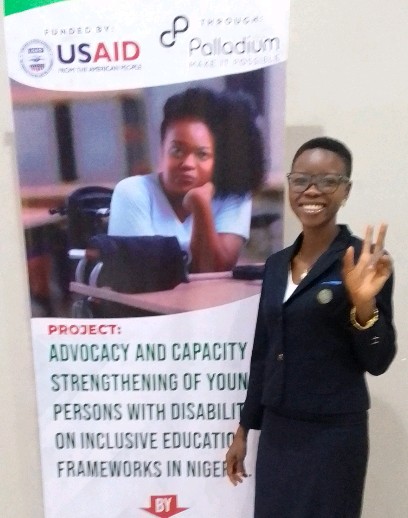
In January 2023, I attended a program in Abuja organized by the JONAPWD National body, focusing on a USAID-sponsored project titled “Advocacy and Capacity Strengthening of Young Persons with Disabilities on Inclusive Education Frameworks in Nigeria.”
Present at the program were representatives from various stakeholders, including policy and decision-makers in the field of education, disability advocates, social development experts, and, of course, young persons with disabilities from different universities across the country. Among the attendees was a young lady in a wheelchair from Bauchi State University, a young man with hearing impairment from the University of Abuja, and other participants from three additional states, including Kaduna State. I represented Anambra State as a student of Nnamdi Azikiwe University, Awka.
During the discussions, each student had the opportunity to narrate their experiences navigating tertiary institutions as persons with disabilities. We listened intently to the deaf young man from the University of Abuja as he shared his story. Every day, he left home for school just like every other student. He boarded the same bus or keke, walked the same pathways, sat in the same classes, and waited for lecturers just like his peers. However, he existed in a world of his own; he could hear no one, and no one could hear him. He watched the lecturers enter the classroom daily and observed their lips move, yet he could capture none of the teachings except what was written on the board. He explained that his only way of keeping up was by collecting and copying notes made by his course mates during lectures.
However, this method of learning posed significant risks, particularly the danger of misinformation. If the course mate whose notes he collected made mistakes, he copied those errors too, as he had no access to the original information. But what if his peers understood sign language or the institution had employed the services of a sign language interpreter? Such support could have bridged the communication gap and made the lectures more accessible to him, minimizing his challenges and boosting his chances of competing favorably with other students. Unfortunately, no provisions were made for him, perpetuating the cycle of marginalization and exclusion.
As a first-year English Language and Literature student at UNIZIK, I faced similar challenges. Attending lectures was a journey marked by infrastructural inaccessibility and administrative oversights. We lacked a permanent classroom, leading to daily uncertainty about where our next lecture would take place. Each morning, we navigated a three-story building housing the whole Faculty of Arts, often moving to another building nearby multiple times within a single day. One day, a lecturer instructed us to move from a classroom at the top floor of the building to the ‘Pit Theatre’ on the ground floor. As students rushed to secure spaces, I trailed behind with my walking aid, only to find everyone seated by the time I arrived.
Suddenly, we were told to return to the original classroom. I struggled to keep up as my peers dashed back up the stairs, only to find them surging down again moments later due to overcrowding in the previous classroom. Exhausted and frustrated, I decided to forfeit the class and sought refuge in a nearby library, reflecting on the challenges of navigating a system that often overlooked the needs of students like me.
What is Inclusive Education?
Inclusive education is an educational approach that aims to guarantee that all children, regardless of their background or abilities, have access to quality learning opportunities. Similar to many other countries, inclusive education in Nigeria seeks to accommodate diverse learning needs, encourage shared and collaborative learning experiences, and promote social cohesion.
However, the lack of inclusivity in most schools in Nigeria continues to pose a significant challenge to the realization of the UN SDG 4 program, which advocates for the Right to Inclusive Education. This goal aims to ensure inclusive and equitable quality education while promoting lifelong learning opportunities for all. The evident lack of inclusivity stems from insufficient awareness, inaccessible facilities, societal misconceptions, and negative attitudes toward children with disabilities. Consequently, this situation has impeded the educational dreams of many children with disabilities, perpetuating the cycle of exclusion.
Therefore, the advocacy for inclusive education in Nigeria requires sustained effort and collaboration from all stakeholders. Every child in Nigeria deserves equal access to quality education, free from discrimination. Schools must create conducive learning environments and implement accessible structures to accommodate children of all abilities. Education is a right, not a privilege.
About The Author