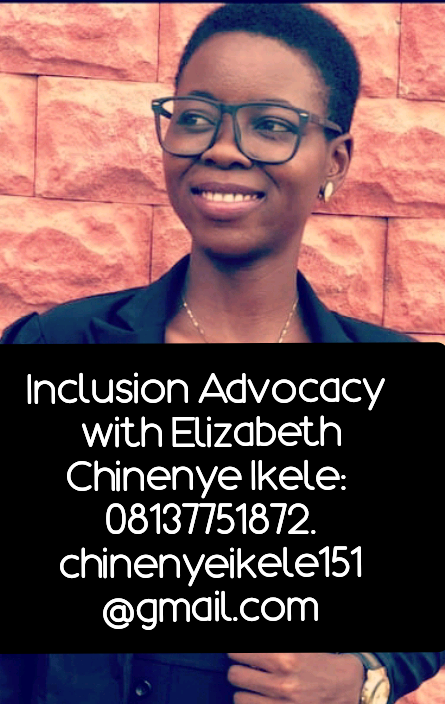
Introduction: Elizabeth Chinenye Ikele is a Nigerian with spinal cord injury and a disability advocate. Having experienced (and still experiencing in different ways) the different challenges that come with being a person with disability, mostly as a result of societal barriers, she focuses on advocating for a more inclusive society for persons with disabilities.
But beyond that, she is a creative writer, using her creative and literary prowess in storytelling to inspire and motivate others, thereby creating the right mindset in them.
Topic: UNSEEN STRENGTHS
~ Transforming Perspectives on Disability
It was past 4pm, and I was descending the staircase towards the entrance of the Faculty of Arts and Humanities, Nnamdi Azikiwe University, Awka. Classes had ended and the faculty was a bit quieter than it usually was earlier in the day during classes, except the rhythmic sound of the local drum coming from the rehearsal by the Theatre department just across the road.
I had stayed back after the day’s classes for a little study. But weariness had crept into my bones and had sent me on my way home.
Right there at the reception hall, I saw him sitting on one of the seats. I had wanted to tiptoe towards him so he wouldn’t be able to detect my lingering footsteps as he always did, but before I could make any further move, something else had grabbed my attention and kept me glued on the staircase.
Opened on his knees was a big blank book. Well, it was blank to me because I could see no words on it as I approached him. His finger tips only moved skillfully to and from the margins of the book.
But that wasn’t the main object of my attention. As I watched him, I noticed his lips were moving. He was muttering something, something I couldn’t hear from my distance. But as I drew closer, still on tiptoe, I could catch something of his words.
“….So his father agreed to divide his wealth between his sons. A few days later this younger son packed all his belongings and moved to a distant land, and there he wasted all his money in wild living. About the time his money ran out, a great famine swept over the land, and he began to starve….”
He was reading! I exclaimed within me. That sounded like some verses from the Scriptures. And to imagine he was looking almost directly at me while he read. But I knew he hadn’t seen me. Couldn’t see me. Yet he could see and read from a book which letters I couldn’t see!
As I finally approached him silently, he paused. He knew someone was there. Someone who was not passing by, but just standing and looking at him. Then came the next shock of the whole experience.
“Is that Elizabeth?” he asked, the pupils in his eyes dancing to and fro, yet unseeing.
I remained silent.
“Elizabeth. That should be you.”
I couldn’t hold it anymore. “This guy, you amaze me! How did you know it was me!” I finally bursted out in astonishment. “Are you sure you’re not faking this whole stuff about being blind?!” I asked jokingly.
He smiled.
“I knew you wanted to hide yourself, but I captured a bit of your footsteps as you drew near.”
I couldn’t argue anything of that. Because I had known his ears to be sharper than the most sophisticated sound detector; and his brain faster than the fastest computer system. But the book on his knees remained my point of attraction.
“What’s this book for?”
“Oh, this. This is a brailled book.”
Braille book! I had heard of something like that before. Braille. That’s a system of writing in which letters and numbers are represented by the combination of different dotse. That was when I noticed the dots on the pages of the book.
“I heard you reading something that sounded like the Scriptures. Is that a Bible?” I asked.
“No, but somehow. It contains the Scriptural readings for Mass. I’m a lay reader in church.”
A lay reader in church! Those are people who read out the Scriptural readings in the Catholic church during Mass.
At that instance, my admiration for this young blind guy who refuses to let his disability become his inability; who had refused to be circumscribed by his visual challenges and the often biased societal perceptions limit him. At that moment also, it dawned on me how much ability lies within each and every one of us, and how much of these abilities we can really tap into for individual and societal development, only if there could be an improved provision of appropriate technology, facilities and trainings/ education.
The societal bias and misconceptions about persons with disabilities, coupled with the lack of provision and unaccessibility of infrastructures, facilities, and support has created a system of constant struggle and vulnerability to most persons with disabilities who are exceptionally gifted in different ways. And as we continue in this, we continue to deny ourselves and the society of these untapped potentials.
Hence, there is need to create a more inclusive society for all; to harness the inherent potential in every person with disability.
As an NGO, international donors and philanthropist, you can partner with The Pinnacle Times today to raise the bar of inclusion in our society by creating more awareness and lending your supports. Email thepinnaclenewsf24@gmail.com
About The Author