...Questions Linger over One-Sided Peace
By Amieyeofori Ibim, Port Harcourt
In what political observers describe as the most significant reconciliation since the presidential peace pact brokered by President Bola Ahmed Tinubu, the Minister of the Federal Capital Territory (FCT), Chief (Barr.) Ezenwo Nyesom Wike, and the Governor of Rivers State, Sir Siminalayi Fubara, have reunited after nearly two years of intense political rivalry that fractured the state’s political establishment and strained governance.
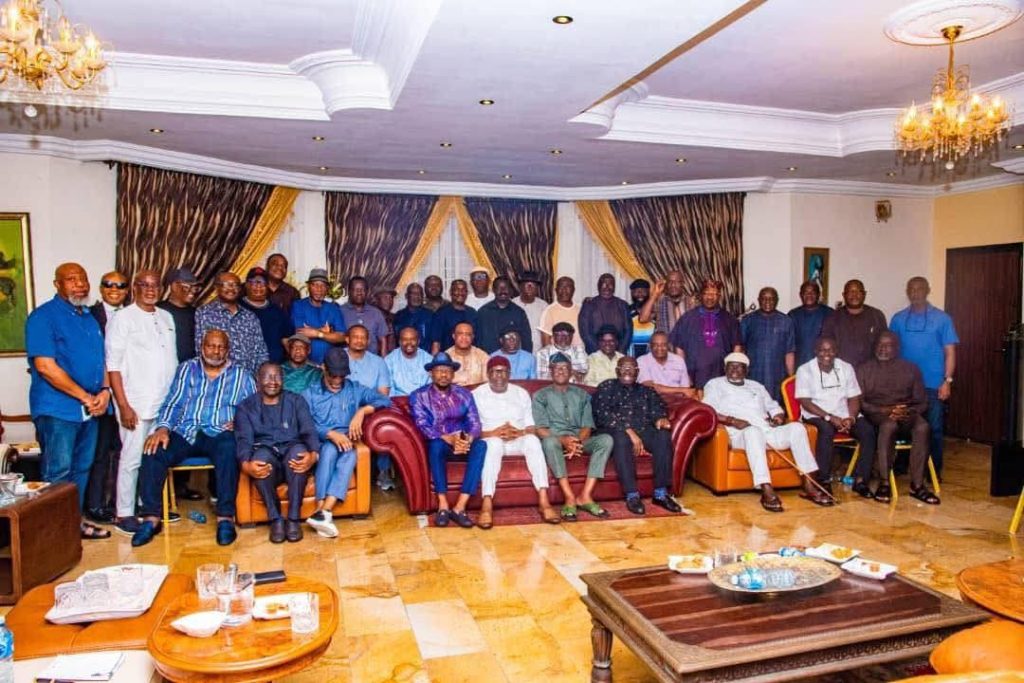
The renewed alliance, sealed on October 4, 2025, is being hailed as a major step toward restoring unity and stability to Rivers State’s turbulent political scene. The meeting brought together an impressive array of political figures — including National Assembly members, the leadership of the Rivers State House of Assembly under Rt. Hon. Martin Amaewhule, and prominent elders and technocrats from both factions.
Among those present were Senators Barry Barinada Mpigi, Magnus Abe, George Sekibo, Olaka Nwogu, and Wilson Ake. Members of the House of Representatives included Hon. Felix Nwaeke (Tai/Oyigbo Federal Constituency) and Hon. Kelechi Nwogu (Etche/Omuma Federal Constituency).
The Rivers State House of Assembly was represented by Rt. Hon. Martin Amaewhule (Speaker), Hon. Dumle Maol (Deputy Speaker), and Hon. Major Jack (Leader of the House). Prominent elders and legal luminaries in attendance included Chief Ferdinand Alabraba (Chairman, Rivers Elders Forum), Chief Sergent Awuse, and Chief (Barr.) OCJ Okocha, SAN.
Also present were three former Attorneys-General — Barr. Frank Owhor, Barr. Ken Chikere, and Barr. Worgu Boms — alongside Prof. Zacchaeus Adangor, SAN, another former Attorney-General and Justice Commissioner.
Other attendees included Chief Victor Giadom (APC National Vice Chairman, South-South), Chief Chukwuemeka Aaron (State PDP Chairman), the Mayor of Port Harcourt, and several political figures such as Hon. Emma Deeyah, Elder Chidi Wihioka, Hon. Dr. Chinyere Igwe, Hon. Ikuinyi Ibani, Chief Boma Iyaye, Chief Marcus Nle Eji, Prof. Ogiri, Chief Chukwuemeka Woke, Dr. Sampson Parker, Dr. Fred Kpakol, Chief Felix Obuah, and Chidi Amadi (Chief of Staff to the FCT Minister).
The reunion is widely regarded as a direct outcome of the peace pact initiated by President Bola Ahmed Tinubu, when tensions between Chief Wike and Governor Fubara reached a crisis point that threatened governance in Rivers State. The President’s intervention, according to insiders, was aimed at preventing political instability that could ripple across the Niger Delta and disrupt national cohesion.
According to Dr. Donald Nwokedi, a lecturer in Political Science, the meeting represents “a vindication of President Tinubu’s strategic mediation.
This reconciliation is a product of calculated presidential diplomacy. Tinubu understood that Rivers State holds immense strategic and political weight in the South-South,” Dr. Nwokedi said. “However, what will determine its success is not the photo opportunity, but how inclusive the peace process becomes in the days ahead.”
Despite the optimism surrounding the meeting, concerns linger that the peace process remains one-sided. Critics say it appears to favour the faction loyal to Chief Wike while alienating the Governor’s core supporters who stood with him during the political standoff.
Notably absent were pro-Fubara legislators such as Rt. Hon. Victor Oko Jumbo, Hon. Sokari Goodboy Sokari, and Hon. Timothy Orubienimigha.
Only Hon. Edison Ehie, who resigned his Assembly seat and now serves as Chief of Staff, Government House, has been visibly accommodated in the new arrangement. Barr. Timi Omonibo, a public affairs analyst, argued that the exclusion of pro-Fubara loyalists “defeats the spirit of reconciliation.”
“You cannot build peace by rewarding those who disrupted governance while ignoring those who maintained it,” Omonibo said. “Both leaders must understand that reconciliation means inclusion — not selective forgiveness.”
Stakeholders across the state are calling for a more comprehensive reconciliation process that cuts across political lines and personal loyalties.
Elder statesmen like Dr. Peter Odili and Dr. Rufus Ada-George, along with respected figures such as Senator John Mbata, who publicly supported Governor Fubara during the conflict, are being urged to play active roles in deepening dialogue.
Mrs. Anyanate Briggs, coordinator of the Rivers Citizens Forum, emphasized that sustainable peace requires humility and balance from both sides. “Peace is not just for leaders; it’s for the people they represent,” Briggs said. “When ordinary citizens see inclusion and fairness, it restores confidence. When they see exclusion, it fuels resentment.”
While the October 4 meeting has been celebrated as a positive development, many Rivers residents remain cautious. Memories of past reconciliations that collapsed under mutual suspicion still linger. Political analyst Celestine Amadi summarized the sentiment succinctly: “This is a welcome development — but it’s fragile. What we saw was a handshake; what we need is a heart change. Until both camps work together beyond the cameras, Rivers State’s peace will remain tentative.”
The renewed handshake between Wike and Fubara may signal a turning point — but its true value will depend on whether inclusivity and genuine forgiveness replace factional control and political mistrust.
About The Author