
By Olawale Lamina
“Nigeria cannot win the war against corruption through arrests and prosecutions alone.
“To build lasting integrity, the country must begin where values are first formed, in the classroom.
The above formed part of the message of the Chairman of the Independent Corrupt Practices and Other Related Offences Commission (ICPC), Dr. Musa Adamu Aliyu, SAN, as he harped on a renewed national focus on legal education as a critical tool for preventing corruption before it takes root.
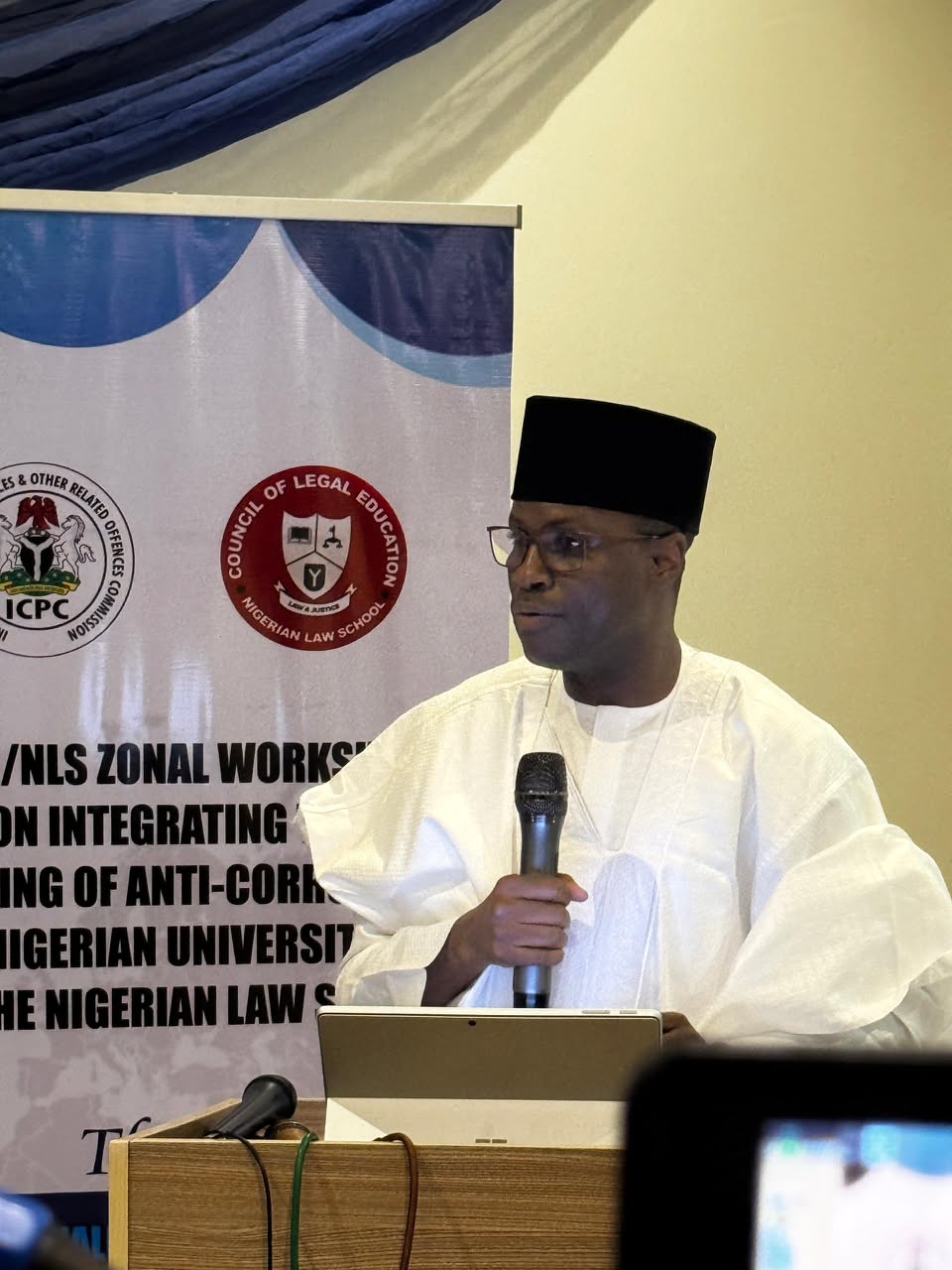
Dr. Aliyu made the disclosure at the ICPC and Nigerian Law School Kano Zonal Workshop themed Integrating Anti-Corruption Education into Nigerian Universities and the Nigerian Law School,
According to the anti-graft Commission’s boss, corruption has continued to exact a heavy price on Nigerians because its consequences are ultimately borne by ordinary citizens.
“The public pays for corruption,” he said, adding that corruption undermines institutions, weakens justice, slows development, and affects every level of society.
Dr. Aliyu noted that the values acquired during legal training often shape the professional decisions lawyers make throughout their careers, making the classroom one of the country’s most important fronts in the fight against corruption.
The ICPC Chairman also observed that, although investigation and prosecution remain essential components of the Commission’s mandate, the country must place equal emphasis on prevention through education.
“There is no more fertile ground for prevention than the classroom,” he stressed, while observing that legal practitioners occupy a unique position within the justice system and that the ethical standards they uphold have far-reaching consequences for governance, accountability, and public confidence.
He cautioned warned that when lawyers jettison ethical principles, the justice system itself is eroded. He urged universities and the Nigerian Law School to ensure that integrity becomes an integral part of legal education rather than an afterthought.
The ICPC boss explained further that the workshop formed part of the Commission’s wider efforts to institutionalize anti-corruption education within legal training and followed an earlier engagement with Deans of Faculties of Law and the Nigerian Law School in Abuja.
Spokesperson of the Commission, Mr. John Okor Odey informed that a similar workshop for the South West is scheduled to take place in Lagos at a yet to be stated date.
The ICPC Chairman stated clearly that the Commission has no intention of prescribing a rigid curriculum. Instead, the objective is to work with legal educators to develop a framework that reflects academic realities while strengthening ethical standards across the profession.
“The Commission will support and facilitate this process,” he assured participants. “We are committed to providing the institutional support required because we believe the impact of this initiative can extend beyond legal education to other professions and eventually across the public sector.”
Dr. Aliyu maintained the idea that a true measure of the workshop’s success will not be the discussions held in Kano but the decisions future lawyers make when faced with ethical choices.
However, in a profound hypothetical scenario, he asked participants to picture a young lawyer, years from now, confronted with the temptation to compromise justice.
“The decision that the lawyer makes,” he said, “will be influenced by the values we choose to teach today.”
And, expressing concern over growing public scrutiny of the legal profession, the ICPC Chairman said that legal education must produce lawyers known not only for their knowledge of the law but also for their commitment to truth, justice, and accountability.
He challenged participants to reflect on whether legal education should produce professionals who strengthen national development or individuals who use their knowledge to frustrate justice.
He equally thanked participants and resource persons for contributing to what he described as an important national conversation, while paying special tribute to Professor Isa Chiroma for his contributions to the initiative.
He seized the occasion to reaffirm the Commission’s commitment to supporting reforms within the legal education system and urged parents, teachers, and members of the legal profession to lead by example in promoting integrity.
“I hope that one day we will all look back with pride and know that we made a difference in the history of this country,” he said.
According to the Commission, the workshop is about far more than reviewing a curriculum. It is about shaping the character of future lawyers and ensuring that those entrusted with defending justice are first taught the value of integrity.
About The Author







