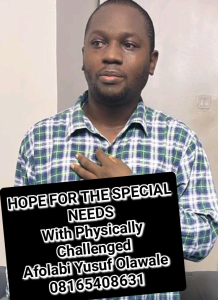
I still vividly remember the period it felt like my world was beginning to crumble. A little sickness after traveling to a new environment quickly escalated into a desperate fight for my sight. Despite being treated for the sickness, taking medications, and hoping to recover soon, my eyesight started to fade away, gradually, until I couldn’t see anymore as I used to.
The hospital became my second home, but despite numerous medical appointments and tests, the doctors couldn’t find anything wrong with my eyes at the time. Frustration and desperation gripped my family and me, driving us to seek spiritual solace. We attended churches, crusades, and prayer vigils, clinging to the hope of a miraculous healing.
I recall the countless prayers, the anointing oils poured into my eyes, and the fervent pleas to God to restore my sight. I observed as others received miraculous healings, their eyesight restored, their hearing regained. But for me, there was only silence. The disappointment and frustration were overwhelming, and I couldn’t help but wonder if I didn’t have enough faith.
But my parents refused to give up. They kept searching for answers, and it wasn’t until we returned to the hospital after a long absence that a doctor finally offered a glimmer of hope. His words, though gentle, were a turning point in my journey: “Since we can’t establish the cause of your eyesight loss, we recommend that you attend a school for the blind.”
And so, I found myself at Parchelli School for the Blind, a place that would become my haven and my hell. It was a journey of self-discovery, of navigating the world in new and unexpected ways.
Seeking Help and Support
If you or someone you know has been diagnosed with a disability, whether temporarily or permanently, it’s essential to take the right steps towards acceptance, adaptation, and rehabilitation. Here are a few steps that can help. These steps helped me learn to live with my disability, and of course the results are still helping me at present. I know some persons who are following these steps to learn to live with their disability, and lots of who having followed these steps are living and thriving with their disabilities as A result of the steps’ outcome. Here are the steps’ below:
1. Seeking Professional Medical Attention
Considering Nigeria as A country struggling with economic illhealth, one of the significant downsides of seeking medical attention is the financial burden it can place on individuals and their families. Medical consultations, tests, and treatments can be expensive, leading to financial strain. However, it’s essential to remember that seeking medical attention is crucial in understanding the nature of the disability and developing a plan for rehabilitation.
By seeking medical attention, individuals can gain access to specialized care, treatment, and support. Medical professionals can provide valuable insights, guidance, and resources to help individuals navigate their disability. While the financial burden can be significant, the benefits of seeking medical attention far outweigh the costs.
2. Accessing Rehabilitation Services
Rehabilitation services are designed to help individuals with disabilities adapt to their new circumstances. One of the upsides of accessing rehabilitation services is the opportunity to develop new skills, regain lost abilities, and learn to navigate the environment in new ways.
However, limited availability especially in a Nigeria, and in the Nigeria-like nations, cost, and funding constraints can create barriers to access. Despite these challenges, rehabilitation services can provide individuals with the tools, support, and confidence they need to thrive. By accessing rehabilitation services, individuals can take control of their lives, build resilience, and achieve their goals.
3. Exploring Assistive Technologies
Assistive technologies can greatly enhance independence and accessibility. But what exactly are assistive technologies? Simply put, assistive technologies are tools, devices, or software that help individuals with disabilities perform tasks, navigate their environment, and communicate with others.
One of the downsides of exploring assistive technologies is the potential complexity and usability issues. Some assistive technologies can be difficult to use, requiring significant training and support, while some might be too costly to acquire. However, the benefits of assistive technologies far outweigh the challenges.
By exploring assistive technologies, individuals can gain greater independence, confidence, and control over their lives. Assistive technologies can open doors to new opportunities, enable individuals to participate fully in their communities, and enhance their overall quality of life.
4. Connecting with Support Networks
Connecting with support networks is vital for emotional support, practical assistance, and valuable insights. But what happens when support networks become overwhelmed or burnt out, or way out of reach? It’s essential to acknowledge the potential emotional burden on caregivers and the risk of social isolation.
Despite these challenges, connecting with support networks can have a profound impact on an individual’s life. Support networks can provide a sense of community, belonging, and connection. By connecting with support networks, individuals can build resilience, cope with challenges, and thrive in the face of adversity.
5. Accessing Education and Training
Education and training are essential for acquiring new skills and adapting to changing circumstances. However, accessibility barriers, financial constraints, and limited job opportunities can create significant challenges.
Despite these challenges, accessing education and training can have a transformative impact on an individual’s life. Education and training can provide individuals with the skills, knowledge, and confidence they need to succeed. By accessing education and training, individuals can build a brighter future, achieve their goals, and realize their potential.
Conclusion
While seeking spiritual healing is a personal choice, like I once opted for, which I’m aware lots of persons who have loved ones with disabilities would want to opt for too, I firmly believe that it’s essential to take practical steps towards rehabilitation and adaptation. Rather than solely relying on performed miraculous healing, I encourage individuals to also pray to God for guidance on how to practically help their loved ones or themselves navigate their disability and thrive with it, hence reality and practicality are married with the religiously spiritual side of the mysterious.
Who am I to underestimate the power of spirituality or the importance of faith in the lives of individuals with disabilities? In fact, might the true God not strike me dead if I DARE an inch to challenge his almightiness? However, I strongly believe that seeking medical attention, accessing rehabilitation services, exploring assistive technologies, connecting with support networks, and accessing education and training are crucial steps in living a fulfilling life with a disability.
By taking these steps, individuals with disabilities can unlock new opportunities, build resilience, and thrive in the face of adversity.Conclusion
While seeking spiritual healing is a personal choice, like I once opted for, which I’m aware lots of persons who have loved ones with disabilities would want to opt for too, I firmly believe that it’s essential to take practical steps towards rehabilitation and adaptation. Rather than solely relying on pastoral miraculous healing, I encourage individuals to also pray to God for guidance on how to practically help their loved ones or themselves navigate their disability and thrive with it, hence reality and practicality are married with the religiously spiritual side of the mysterious. Who am I to underestimate the power of spirituality or the importance of faith in the lives of individuals with disabilities? In fact, might the true God not strike me dead if I DARE an inch to challenge his almightiness? However, I strongly believe that seeking medical attention, accessing rehabilitation services, exploring assistive technologies, connecting with support networks, and accessing education and training are crucial steps in living a fulfilling life with a disability. By taking these steps, individuals with disabilities can unlock new opportunities, build resilience, and thrive in the face of adversity.
A Final Note
The steps outlined in this article are based on my personal experiences, observations, and insights gained from interacting with individuals living with disabilities. While I hope that these steps will be helpful, I must emphasize that they are not a substitute for professional medical advice. If you or someone you know is experiencing health challenges or concerns, it is essential to consult with qualified healthcare professionals for personalized guidance and support. I invite you to share your thoughts, experiences, and insights on navigating life with a disability. Your stories and perspectives can help inspire and empower others to thrive in the face of adversity.
About The Author