
By Olawale Lamina
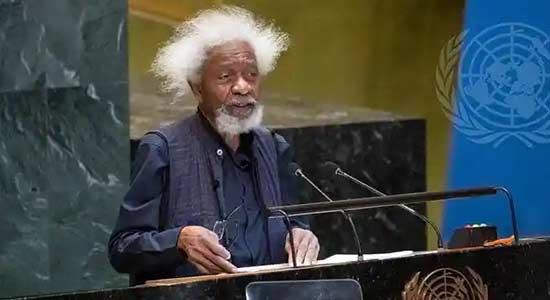
Nobe Laureate, Professor Wole Soyinka has made a stringent call for an urgent need to put and end to modern day slavery in whatever forms it appears.
This was contained in his address as the keynote speaker at the commemoration of this year’s International Day of Remembrance for the Victims of Slavery and the Transatlantic Slave Trade which came under the theme: ““Acknowledge the past. Repair the present. Build a future of dignity and justice, ” held at the headquarters of the United Nations in New York on Tuesday.
The 90-year-old professor of Comparative Literature and human rights activist lamented high incident of slave tade in many parts of the world and particularly in Africa, despite all efforts geared towards eradicating the menace.
He blamed major world religions for providing a haven for slave trade, observing that slavers now include communities, individuals and races, making it difficult to recognize contemporary forms of the practice.
He said: “Extant slave markets endure in notable parts of the world, including, most ironically, within the resource centre itself – the African continent. Establishing this for Doubting Thomases is easy though – we can lead you to them, physically.
“Often more difficult to establish, however, is the condition itself that constitutes slavery. Yet we must address it. We must, since one is fed by, and feeds on the other, creating a vicious cycle. The agent of that condition can be an individual, a community, a class, a race, or a religion.”
He made reference to the abduction of 279 schoolgirls in Nigeria , stating that that was one of the illustration of the modern day slavery, where slavers took their victims with a ready market to negotiation in exchange for money.
The laureate highlighted the role of religion in perpetuating slavery, alleging that world religions are now complicit in the exploitation of Africans to carry out the transatlantic slave trade.
“The self-acclaimed world religions worked hand in hand with militarism for the promotion of the lucrative trade on the African continent, as did the instrumentality of laws and edicts,” he stated.
Soyinka advocate a collective effort to address the ongoing conditions of slavery that continue to affect races of the world.
Professor Soyinka was accompanied at UNGA by the Chief Executive Officer of Nigerians in Diaspora hon. Abike Dabiri
About The Author







