

On a tense Tuesday morning in Abuja’s Gaduwa District, the red dust rose not from bulldozers but from egos colliding. There, under a pale November sun, two symbols of power—Minister Nyesom Wike and a young military officer, Lieutenant Ahmad M. Yarima—met in a confrontation that has since captured national attention.
It began, as so many Nigerian dramas do, with land. The Federal Capital Territory Minister stormed the site to halt what he called an illegal takeover of government property. The officer, in full military camouflage, insisted he was acting lawfully. The brief exchange turned volcanic.
“Because you are an officer?” Wike barked, his voice echoing through the site. “Nobody does that.” The officer stood his ground: “I am an officer with integrity.” Wike, visibly infuriated, ordered him to keep quiet. The officer refused. And then came the insult that lit the match: “You are a very big fool.”
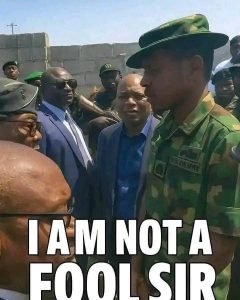
By nightfall, the video had gone viral, dividing the nation. Some hailed Wike’s courage to confront military impunity. Others saw a dangerous display of arrogance—an elected official berating a man in uniform. It was not just a quarrel over land; it was a test of the fragile balance between civilian authority and military dignity.
Wike’s defense was swift and firm. He said soldiers had chased away officials of the Federal Capital Territory Administration enforcing his directive against illegal construction. To him, it was an assault on law and order. “No one,” he said, “no matter their former position, will be allowed to intimidate the government.”
In truth, Wike’s frustration was not without merit. Abuja has long been scarred by land racketeering and unapproved developments. The FCT’s Master Plan has been trampled by privilege and impunity. Since assuming office, Wike has been on a mission to reclaim the capital’s lost order. Bulldozers have rolled, titles have been revoked, and the powerful have been rattled.
But this time, the line blurred. Wike’s passion for order veered into confrontation. His words, though anchored in law, carried a sting that undercut their purpose. Governance, after all, is not only about being right—it is about acting right.
The military’s response was measured but unmistakable. The Chief of Defence Staff, Mohammed Badaru, commended the officer for his restraint, calling it “a reflection of discipline and emotional intelligence.” In that calm praise lay a subtle rebuke. Civility, it seemed, had swapped uniforms that day.
Then came the thunder of a retired general. Former Army Chief, Tukur Buratai, described Wike’s conduct as “a clear threat to national security.” His warning was stern: that a minister’s verbal assault on a uniformed officer undermined military morale and national stability.
That view, while exaggerated, speaks to a deeper unease in Nigeria’s democracy. Old habits die hard. The ghost of military supremacy still haunts our civic space. But democracy cannot be held hostage to bruised egos in uniform. Civilian oversight is not disrespect—it is constitutional order.
Still, Wike’s outburst did more harm than he realizes. By descending into insult, he shifted attention from the illegality of the land deal to the legality of his temper. Leadership, especially at his level, demands not the loudness of command but the quiet weight of composure.
The officer’s restraint, on the other hand, spoke volumes. In his silence, Nigerians saw a new kind of soldier—disciplined, self-controlled, professional. In his refusal to mirror anger with anger, he represented the best of a military learning to live within democratic limits.
The Gaduwa encounter, then, was more than a spat; it was a parable. A test of how far Nigeria has travelled from the days when khaki ruled with iron and fear. Wike stood for civilian authority; the officer stood for military discipline. Both, in their own ways, defended the Republic.
Yet, both also faltered. The military must not insert itself into civil land disputes. The minister must not turn enforcement into theatre. Power, whether worn on the shoulder or wielded behind a desk, demands humility.
Abuja’s endless land wars mirror the nation’s larger struggle—between rule and impulse, between law and personality. The Master Plan Wike seeks to restore is not just a blueprint for buildings; it is a metaphor for order itself.
In a sense, the Gaduwa confrontation was inevitable. Two strong institutions met at a fault line of power—and cracked it open. One wielded legal authority, the other institutional pride. Both claimed to defend the public interest.
President Bola Tinubu, as Commander-in-Chief, will now have to mediate this friction quietly. The lesson is clear: respect for uniform must not erase respect for law. And civilian authority must never descend into personal insult.
Nigeria’s democracy is still learning its manners. The rule of law must not be enforced with rage, nor must discipline become a shield for impunity. Between Wike’s fury and the soldier’s silence lies the fragile balance we must all protect.
In the end, Gaduwa was not just about a plot of land. It was about the soul of Abuja—the capital of order, now caught between legality and ego. And perhaps, if our leaders can learn from that dusty confrontation, it might yet become the city its founders dreamed of: one ruled by reason, not rancour.
_Amieyeofori Ibim is a seasoned Journalist, Political Analyst and Public Affairs Commentator._
ibimdarlinton@gmail.com
08112095925
About The Author








