
By Ola Kay
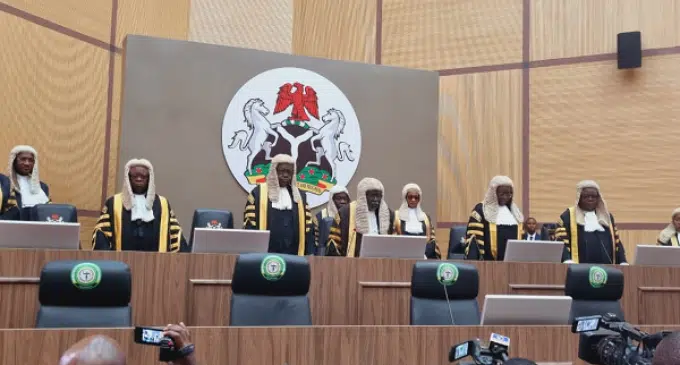
The Supreme Court on Tuesday reserved judgment in a suit filed by ten Peoples Democratic Party (PDP)-controlled states challenging President Bola Tinubu’s declaration of a state of emergency in Rivers State.
A seven-man panel of justices, led by Justice John Inyang Okoro, adjourned the matter after all parties adopted their written addresses. The date for the judgment will be communicated to the parties later.
At the commencement of the proceedings, the fifth plaintiff—Delta State—withdrew from the suit, a decision that was not opposed by counsel to the Federal Government, Attorney-General of the Federation (AGF) Lateef Fagbemi, SAN.
The plaintiffs, represented by Eyitayo Jegede, SAN, maintained that their action was not a denial of the President’s constitutional power to proclaim a state of emergency, but a challenge to the scope of that power. Jegede argued that the proclamation should not extend to suspending or displacing the offices of the governor, deputy governor, or the state House of Assembly.
In his response, Fagbemi argued that the plaintiffs had failed to demonstrate that there was no security threat or political crisis in Rivers State to justify the President’s action. He told the court that the state was engulfed in a deep political conflict between the governor and the legislature, which necessitated extraordinary measures to restore order.
According to him, the Governor, his Deputy, and members of the House of Assembly were not removed but “suspended” temporarily as part of the emergency measures. “The President had no choice but a duty to act the way he did,” Fagbemi said, urging the court to dismiss the suit in its entirety.
Counsel for the National Assembly, Charles Yoila, aligned himself with the AGF’s submissions and also prayed the court to dismiss the case.
President Tinubu, on March 18, 2025, declared a state of emergency in Rivers State, citing escalating political tensions, security breaches, and disruptions to oil production facilities. The move followed weeks of confrontation between Governor Siminalayi Fubara and members of the State House of Assembly loyal to his predecessor, Nyesom Wike.
The proclamation led to the suspension of the governor, his deputy, and the state legislature, with retired Vice Admiral Ibok-Ete Ibas appointed as Sole Administrator for an initial six-month period—an action that drew widespread controversy and legal challenges.
The PDP states—represented by their Attorneys-General—approached the Supreme Court to test the constitutionality of the President’s decision, arguing that it contravened Sections 1(2), 5(2), 192(4)-(6), and 305 of the 1999 Constitution (as amended). They sought declarations that the suspension of elected officials and the installation of a sole administrator were unconstitutional and void.
The Federal Government, in turn, contended that the declaration complied with constitutional provisions and was necessary to preserve peace and governance in the oil-rich state.
The apex court’s judgment is expected to clarify the scope of presidential powers under a state of emergency and define the constitutional limits of federal intervention in state affairs. Legal observers say the ruling could set a major precedent for Nigeria’s federal structure and democratic governance.
About The Author







